
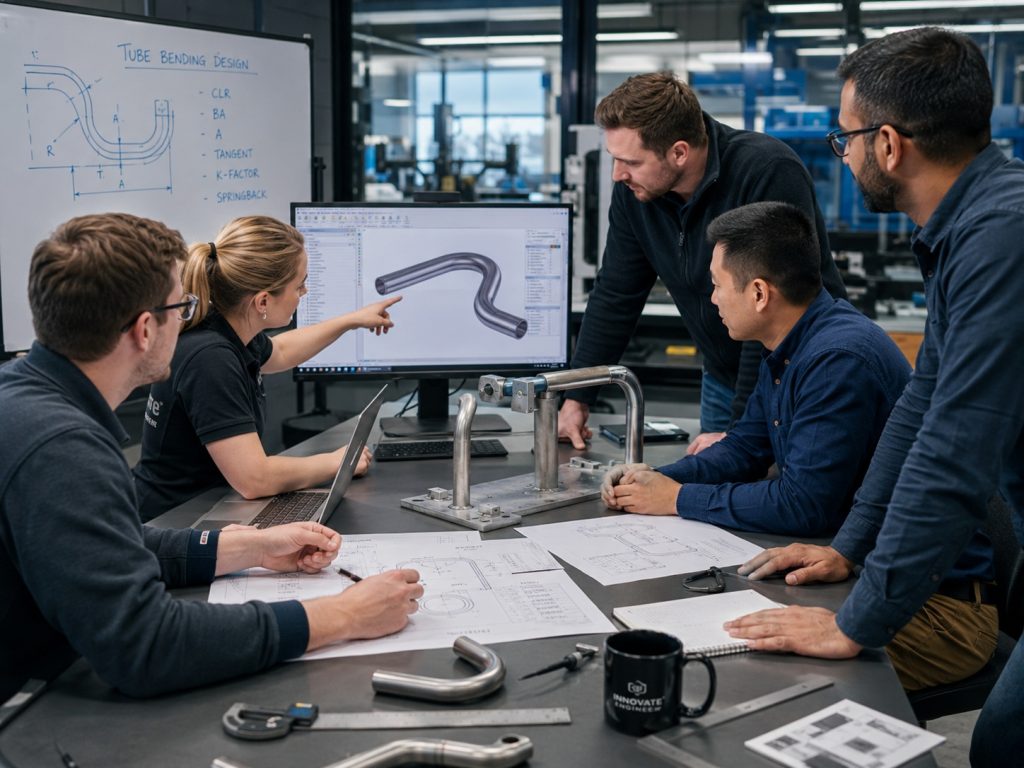
When companies evaluate a tube bending supplier, they often focus on machinery, materials, pricing, and production capacity. Those factors are important, but another capability can have just as much influence on the finished part: tooling.
Tube bending tooling is not simply an accessory attached to a machine. It controls and supports the tube throughout the bending process. The tooling selected for a project can affect the bend radius, surface quality, dimensional consistency, ovality, wall thinning, and overall manufacturability of the component.
For custom parts, tight-radius bends, specialty materials, and moderate production volumes, access to in-house tooling expertise can make a significant difference.
Every bent tube begins with a desired geometry. The challenge is producing that geometry without creating wrinkles, excessive flattening, cracks, unwanted springback, or dimensional variation.
The required tooling may include a bend die, clamp die, pressure die, mandrel, wiper die, or a combination of components. The correct setup depends on several project details, including:
A tooling strategy must account for how the material behaves while it is being formed. Stainless steel, carbon steel, aluminum, and specialty alloys do not respond to bending forces in exactly the same way. Thin-wall tubing and severe-radius bends may also require additional support to maintain the desired shape.
When tooling can be evaluated, designed, or adjusted in-house, the people developing the bend can work directly with the people producing the tooling. That connection can help resolve manufacturability challenges before they become production problems.
A custom bending project does not always require completely new tooling. An experienced tube bending company may already have a die that matches, or closely matches, the required tube diameter and centerline radius.
Using an existing die can potentially reduce the amount of new tooling needed for a project. It may also help the supplier begin development sooner.
This is one reason it can be helpful to involve a tube bending specialist before every dimension is permanently locked into a design. When the application allows some flexibility, a small adjustment to the bend radius may make it possible to use existing tooling without affecting the component’s intended function.
Tooling availability should not determine every engineering decision. However, understanding available options during the design stage can help teams balance performance, manufacturability, project timing, and total cost.
Custom tube components occasionally present challenges that are difficult to identify from a drawing alone. Material variation, springback, short tangent lengths, weld seams, or interactions between multiple bends may become more apparent during the first trial parts.
When tooling work is outsourced, every adjustment can require communication with another vendor. The tool may need to be shipped, modified, returned, installed, and tested again.
In-house tooling eliminates some of those handoffs. The bending and tooling teams can inspect the same part, discuss the same issue, and evaluate potential adjustments together.
Depending on the project, an adjustment might involve changing support around the bend, refining a tooling surface, compensating for springback, or developing a specialized component for an unusual geometry. Keeping these capabilities under one roof can make the development process more responsive.
Producing one acceptable tube is only the beginning. A successful manufacturing process must also produce consistent parts throughout the required production run.
Well-designed tooling helps locate, clamp, support, and release each tube in a controlled way. This can improve repeatability in areas such as:
Consistency becomes especially important when the bent tube is part of a larger welded or brazed assembly. Variations in one component can create alignment problems during assembly or cause difficulties when the finished product is installed.
Tooling, process planning, inspection, and operator experience must work together. In-house tooling gives the fabrication team another way to control the process rather than relying solely on adjustments at the bending machine.
High-volume manufacturing is often built around dedicated tooling and highly automated processes. Custom and moderate-volume projects may require a different approach.
These projects can involve replacement components, specialized industrial equipment, prototypes, design revisions, or parts that are needed regularly but not in mass-production quantities. Creating an economical process for these applications requires flexibility.
In-house tool design and manufacturing can help a tube bending company develop an approach suited to the actual project instead of forcing the part into a production system designed for a different volume.
The result may be a practical path from an early concept or sample part to a repeatable finished component.
Before placing an order, consider discussing the following questions with your tube bending supplier:
These conversations can uncover opportunities to improve the design before material is cut or production tooling is completed.
Detroit Tube Products has specialized in tube bending and fabrication since 1911. Our capabilities include tube bending from 3/4-inch through 6-inch outside diameter, severe-radius bending, close-tolerance work, tube forming, welding, brazing, and custom assemblies.
Our extensive die inventory and on-site tool design and manufacturing capabilities help us support unusual geometries, specialty materials, tight bends, and custom production requirements.
Have a tubular component that other suppliers have struggled to produce? Send Detroit Tube Products your drawing, CAD file, sample part, or early-stage concept. Our team will review the design, available tooling, material requirements, and production needs to help identify a practical manufacturing solution.
Request a quote for your next custom tube bending or fabrication project.
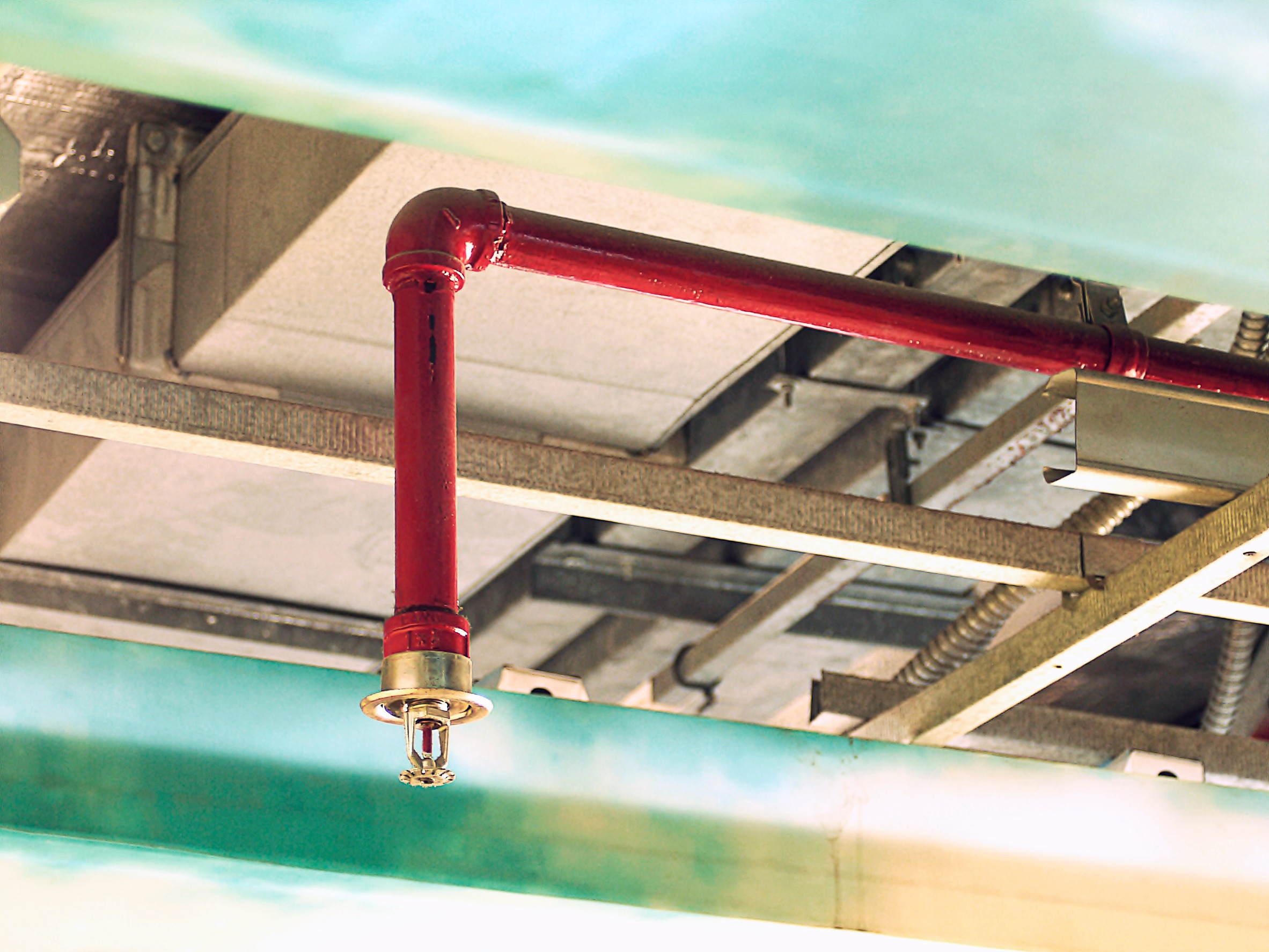
Custom tube bending is necessary for a variety of industries, especially for fire suppression and other fire fighting systems. Fire suppression systems are very important for prevention, control, or extinguishing fires. They can be found in almost every type of building around the world. Often these system set within very constraining spaces occupied by a myriad of other systems like ductwork and plumbing. In an industrial setting, it can become even more precarious. For that that reason, custom tube bending for many fire suppression systems are required.
To clarify what kind of suppression system we are discussing, let’s go over the type of fire suppression systems that would require some custom tube bending. First is the water-based suppression systems like sprinklers that can release various levels of water to prevent a fire from spreading. It’s classic method but comes with the downside of your electronic might get damaged. However, evolution in fire protection actually has added alternatives to using water.
Chemical Foam has become a popular alternative to water for kitchens fires because it causes minor damage and easier to use. However, this system needs specialized tubing. For environments with high-end technology or servers, pressurized gas is used to suppress a fire. The gas causes a chemical reaction that will extinguish the fire on contact. But what about suppressing a fire near a transformer? If the area restricts the use of water suppression, a foam deluge system might be used to ensure there are not bad reactions to the fire and water.
All of these systems are very different and often need special materials to make sure these suppression systems work!
Custom tubing for fire suppression systems have been commonplace for many years. People often need specific bends to help with the installation process, especially in tight spaces. However, with new types of systems being used, they also have been changing the type of materials used. While a water-based systems doesn’t require stainless steel, chemical foam suppression does because it can eat away at other materials. Foam Deluge needs weather resistant because this suppression system is often outside.
That is why companies rely on Detroit Tube Product to help with their custom tube bending! From Forestry to Pools/Spas, we can help you meet your needs for any job that requires precision bends!
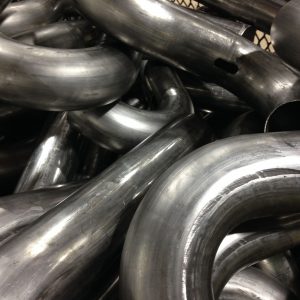
At Detroit Tube Products, custom tube bending is our specialty. In fact, everything we do is custom fabrications. Unlike home improvement like the Home Depot, we do not have a catalog for clients to pick and choose from. Instead, everything is made on your design. Your design, your way. And here’s how!
As mentioned above, we aren’t your local home improvement store. At a regular shop, people a relegated to choosing between a certain selection of materials. However, that is not the case at Detroit Tube Products. Our inventory allows clients to select all materials used in low-pressure applications. In addition, our company has 316, 304, and 400 stainless steel options in our tubing stock. However, that is not all that you customize.
The beautiful thing about custom tube bending is that you can choose the shape and size of the bend. As mandrel benders, Detroit Tube Products is capable of bending all tube materials and shapes. At our company, the sizes that are available are:
In addition to an extraordinary amount of size, the type of tube forming that we do is just as large! Some shapes that we can produce are:
You might be wondering if custom fabrications mean that we cannot produce a large quantity. However, that isn’t the case. At Detriot Tube Products, you can order a single piece to moderate production of 1000 pieces per month. Whatever you need for your project, we are capable of producing. This also applies to our assemblies as well. All of these can be ordered to your specifications!
Detroit Tube Products’ ability to make custom fabrications for a variety of industries. Whether you are looking for tube bending, tube shaping, or assemblies, we can create every part you need! Since 1911, we pride ourselves in providing the best possible service. With over a century of experience under our belt, your satisfaction is guaranteed. So, call us today or submit a quote!