
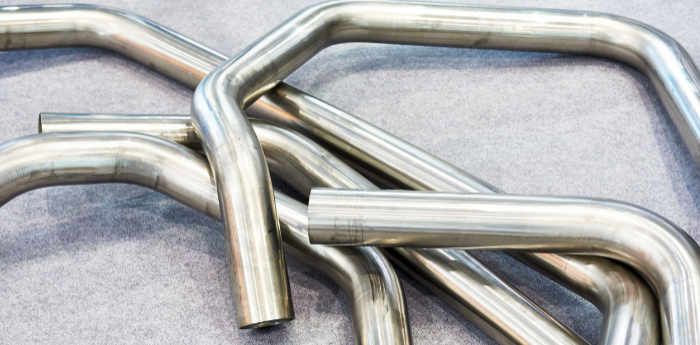
When your project requires accurate, dependable steel tube bending services, experience matters. Detroit Tube Products has been providing tube bending and metal fabrication solutions since 1922. With more than a century of industry experience, our team has the knowledge and equipment needed to create precision bends for a wide variety of applications.
From straightforward bends to complex tube configurations, we work with customers to determine the right bending process for their material, tube shape, bend radius, and finished application. Whether you need components for automotive, aerospace, heavy equipment, or another demanding industry, Detroit Tube Products can help.
Not every tube bending project is the same. Tube diameter, wall thickness, material, shape, bend radius, and final application can all affect how a part should be formed.
Detroit Tube Products has experience bending a variety of tube profiles, including:
Our team evaluates each project to determine the best approach for producing a consistent, accurate bend while minimizing distortion.
This experience is especially important when working with steel tubing. During the bending process, improper tooling or technique can result in problems such as wrinkling, flattening, excessive stretching, or unwanted changes to the tube’s cross-section.
Different applications may require different tube bending techniques. Detroit Tube Products has extensive experience with multiple bending processes and can determine which method is appropriate for the requirements of a particular component.
One commonly used method is rotary draw bending.
During rotary draw bending, the tube is secured and drawn around a bend die with a specified radius. The process provides excellent control over the finished geometry and is useful when a project requires repeatable, precise bends.
Proper tooling and clamping pressure are extremely important during this process. If there is not enough pressure, the tubing may slip while it is being formed. Too much pressure can potentially mark, distort, or wrinkle the material.
Experienced tube bending specialists understand how to balance tooling, pressure, material characteristics, and bend requirements to produce a quality finished component.
Depending on the project, other bending processes may also be considered to achieve the required shape and performance.
Although steel tube bending is one of our core capabilities, Detroit Tube Products works with several different materials.
Depending on the specifications of the project, materials may include:
Every material behaves differently during forming. Characteristics such as hardness, wall thickness, ductility, and springback must be considered when planning a bend.
Our decades of metal forming experience help us select the proper equipment, tooling, and process for the material being used.
Bent tubing is used throughout manufacturing because it allows engineers and designers to route structural components, fluids, exhaust systems, and other assemblies through limited spaces while maintaining strength and performance.
Detroit Tube Products provides tube fabrication capabilities for many industries, including:
These industries often require more than simply putting a bend into a piece of tubing. Parts may need to meet detailed dimensional specifications while fitting precisely into a larger assembly.
That is why choosing an experienced tube bending company can make an important difference.
Tube bending may look simple, but producing accurate, repeatable bends requires the right combination of machinery, tooling, engineering knowledge, and hands-on experience.
A poorly planned bend can lead to unnecessary material waste, dimensional problems, distortion, or components that do not fit correctly during final assembly.
Detroit Tube Products has been solving tube fabrication challenges since 1922. Our extensive history in the industry has allowed us to work with countless tube configurations, materials, and applications.
Whether your project involves a simple bend or a more complicated fabricated tube assembly, our team can help evaluate your requirements and determine an effective manufacturing approach.
If you need dependable steel tube bending services in Michigan, put more than 100 years of tube fabrication experience behind your next project.
Detroit Tube Products works with customers across numerous industries to produce high-quality bent tubing and fabricated components designed around their individual specifications.
Call us today at 313-841-0300 or contact Detroit Tube Products to discuss your project, specifications, and tube bending requirements.
Let our experienced team help you find the right solution for your next steel tube bending project.
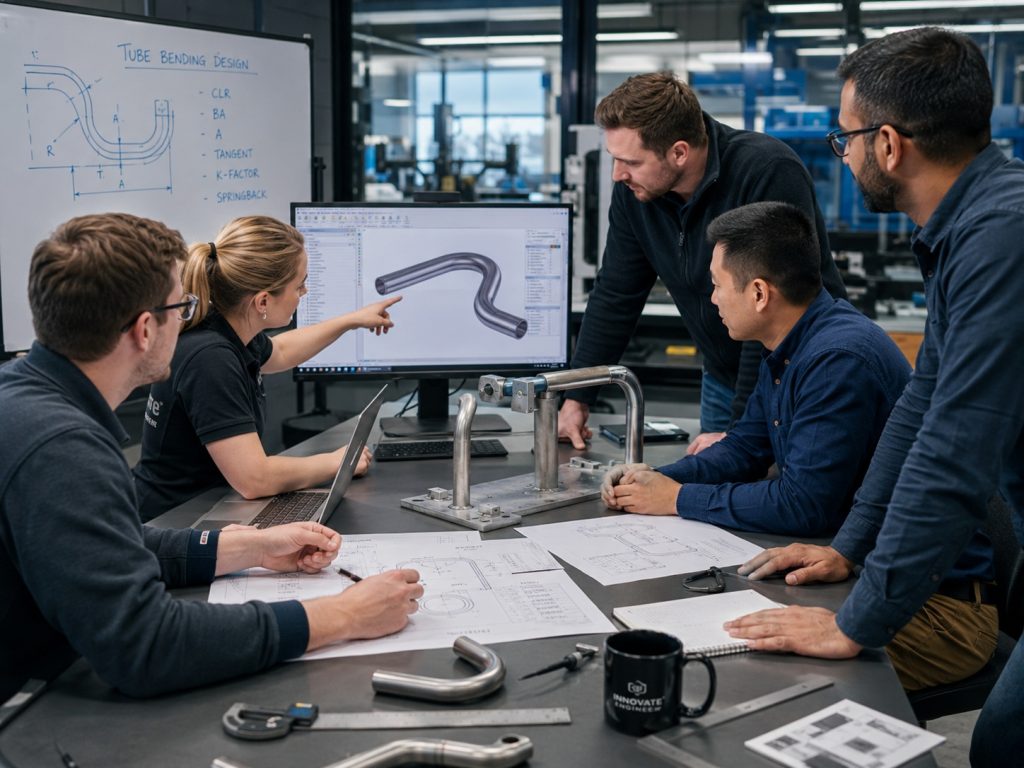
When companies evaluate a tube bending supplier, they often focus on machinery, materials, pricing, and production capacity. Those factors are important, but another capability can have just as much influence on the finished part: tooling.
Tube bending tooling is not simply an accessory attached to a machine. It controls and supports the tube throughout the bending process. The tooling selected for a project can affect the bend radius, surface quality, dimensional consistency, ovality, wall thinning, and overall manufacturability of the component.
For custom parts, tight-radius bends, specialty materials, and moderate production volumes, access to in-house tooling expertise can make a significant difference.
Every bent tube begins with a desired geometry. The challenge is producing that geometry without creating wrinkles, excessive flattening, cracks, unwanted springback, or dimensional variation.
The required tooling may include a bend die, clamp die, pressure die, mandrel, wiper die, or a combination of components. The correct setup depends on several project details, including:
A tooling strategy must account for how the material behaves while it is being formed. Stainless steel, carbon steel, aluminum, and specialty alloys do not respond to bending forces in exactly the same way. Thin-wall tubing and severe-radius bends may also require additional support to maintain the desired shape.
When tooling can be evaluated, designed, or adjusted in-house, the people developing the bend can work directly with the people producing the tooling. That connection can help resolve manufacturability challenges before they become production problems.
A custom bending project does not always require completely new tooling. An experienced tube bending company may already have a die that matches, or closely matches, the required tube diameter and centerline radius.
Using an existing die can potentially reduce the amount of new tooling needed for a project. It may also help the supplier begin development sooner.
This is one reason it can be helpful to involve a tube bending specialist before every dimension is permanently locked into a design. When the application allows some flexibility, a small adjustment to the bend radius may make it possible to use existing tooling without affecting the component’s intended function.
Tooling availability should not determine every engineering decision. However, understanding available options during the design stage can help teams balance performance, manufacturability, project timing, and total cost.
Custom tube components occasionally present challenges that are difficult to identify from a drawing alone. Material variation, springback, short tangent lengths, weld seams, or interactions between multiple bends may become more apparent during the first trial parts.
When tooling work is outsourced, every adjustment can require communication with another vendor. The tool may need to be shipped, modified, returned, installed, and tested again.
In-house tooling eliminates some of those handoffs. The bending and tooling teams can inspect the same part, discuss the same issue, and evaluate potential adjustments together.
Depending on the project, an adjustment might involve changing support around the bend, refining a tooling surface, compensating for springback, or developing a specialized component for an unusual geometry. Keeping these capabilities under one roof can make the development process more responsive.
Producing one acceptable tube is only the beginning. A successful manufacturing process must also produce consistent parts throughout the required production run.
Well-designed tooling helps locate, clamp, support, and release each tube in a controlled way. This can improve repeatability in areas such as:
Consistency becomes especially important when the bent tube is part of a larger welded or brazed assembly. Variations in one component can create alignment problems during assembly or cause difficulties when the finished product is installed.
Tooling, process planning, inspection, and operator experience must work together. In-house tooling gives the fabrication team another way to control the process rather than relying solely on adjustments at the bending machine.
High-volume manufacturing is often built around dedicated tooling and highly automated processes. Custom and moderate-volume projects may require a different approach.
These projects can involve replacement components, specialized industrial equipment, prototypes, design revisions, or parts that are needed regularly but not in mass-production quantities. Creating an economical process for these applications requires flexibility.
In-house tool design and manufacturing can help a tube bending company develop an approach suited to the actual project instead of forcing the part into a production system designed for a different volume.
The result may be a practical path from an early concept or sample part to a repeatable finished component.
Before placing an order, consider discussing the following questions with your tube bending supplier:
These conversations can uncover opportunities to improve the design before material is cut or production tooling is completed.
Detroit Tube Products has specialized in tube bending and fabrication since 1911. Our capabilities include tube bending from 3/4-inch through 6-inch outside diameter, severe-radius bending, close-tolerance work, tube forming, welding, brazing, and custom assemblies.
Our extensive die inventory and on-site tool design and manufacturing capabilities help us support unusual geometries, specialty materials, tight bends, and custom production requirements.
Have a tubular component that other suppliers have struggled to produce? Send Detroit Tube Products your drawing, CAD file, sample part, or early-stage concept. Our team will review the design, available tooling, material requirements, and production needs to help identify a practical manufacturing solution.
Request a quote for your next custom tube bending or fabrication project.