The more complete your tube bending information is, the faster we can review your project, confirm feasibility, and provide an accurate quote.
At Detroit Tube Products, we work with customers on custom tube bending, tube forming, fabricated tube assemblies, welded assemblies, and specialty tubular parts. Whether you have a detailed engineering print, a CAD file, a sample part, or even an early project concept, sending the right information up front helps us reduce back-and-forth and move your quote forward faster.
This guide explains what to include when requesting a quote for a bent tube, formed tube, or tube assembly.
Ready to send your project?
A tube bending quote depends on more than the shape of the part. Material, tube size, bend radius, tolerances, quantity, end forms, welding, finishing, and testing requirements can all affect manufacturability, tooling, pricing, and lead time.
For the fastest review, please send as much of the following information as possible.
Please include the basic tube dimensions:
Examples:
If you are not sure of the wall thickness, send the material specification, part drawing, or a photo of the existing tube. We can help review what information is missing.
Material affects how the tube bends, how much springback to expect, what tooling may be required, and whether the part may need special handling.
Please include the material type and grade when possible.
Common examples include:
For stainless steel projects, include the grade if known, such as 304 or 316 stainless. For pressure, fluid, engine, exhaust, or industrial applications, please include any required material specification.
The bend radius is one of the most important details in a tube bending quote.
Please include the required:
The centerline radius is the distance from the center of the tube to the center point of the bend. This is usually the key radius needed for tube bending.
Example:
A tighter radius may require different tooling, mandrel bending, additional forming consideration, or special review. If the bend radius is flexible, please mention that. Existing tooling may help reduce cost and lead time when a standard or available radius can be used.
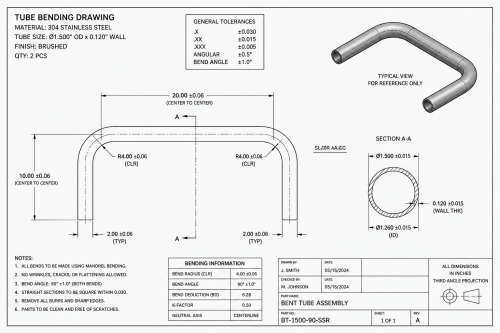
For each bend, include the angle and location. A drawing is the best way to communicate this, but written dimensions can also help.
Useful details include:
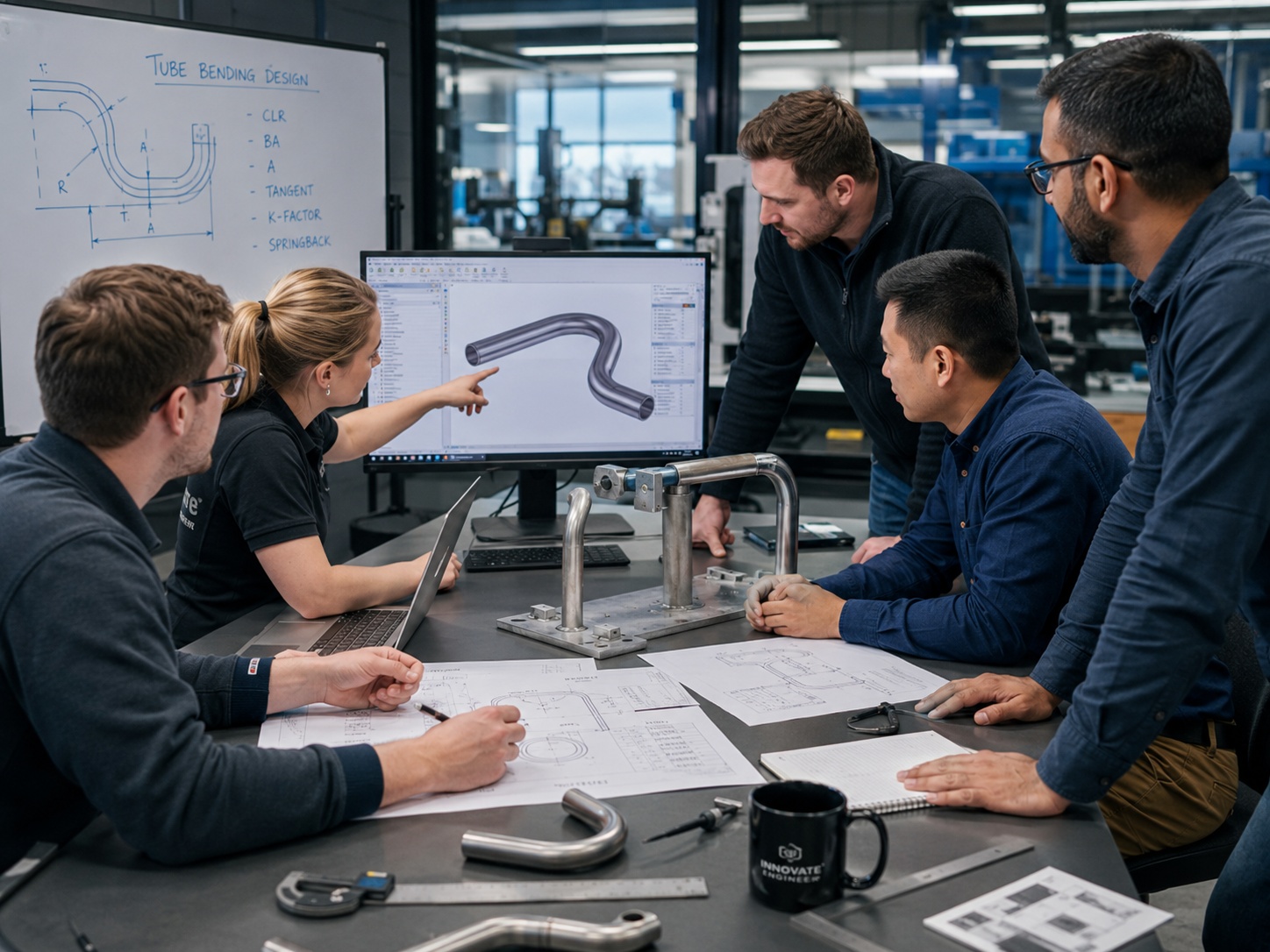
For multi-bend parts, a 2D or 3D drawing is especially helpful. Even a marked-up sketch can speed up the quoting process if it clearly shows the basic shape and dimensions.
Please include any required tolerances for the part.
Important tolerance areas may include:
If your project does not require tight tolerances, let us know. Overly tight tolerances can increase cost, inspection time, and production complexity. When the application allows for standard commercial tolerances, the quote may be more efficient.
Quantity helps determine the best production approach.
Please include:
Small runs, repeat production, replacement parts, and production assemblies may each require a different quoting approach. Sharing expected usage helps us recommend the most practical manufacturing path.
The best quote requests usually include one or more of the following:
A formal engineering drawing is ideal, but it is not always required to start the conversation. If your project is still in development, send what you have. We can often review early concepts and help identify what information is still needed.
For reverse-engineered or replacement parts, photos and sample parts can be especially useful.
Let us know if the tube needs any end work, such as flaring, beading, expanding, reducing, swaging, flanging, holes, slots, O-ring seats, special cuts, or deburring.
If the tube connects to a hose, fitting, flange, bracket, or other component, include that information with your quote request.
Tell us if the bent tube is part of a larger assembly.
Include any requirements for welded brackets, bosses, flanges, fittings, mounting tabs, tube-to-tube assemblies, MIG or TIG welding, brazing, leak testing, pressure testing, or fixture fit-up.
Please include any finish or post-processing needs, such as paint, powder coating, plating, passivation, polishing, protective oil, special cleaning, caps, plugs, rust prevention, labeling, or special packaging.
A short description of how the tube will be used helps us review the project.
Examples include fluid transfer, exhaust, engine components, structural supports, guards, decorative parts, fire suppression, foodservice equipment, marine parts, heavy equipment, generators, or replacement/restoration parts.
Let us know if the part requires pressure testing, leak testing, material certifications, inspection reports, PPAP, weld inspection, traceability, serialization, or special shipping documentation.
For confidential or export-sensitive projects, please tell us before sending restricted files or technical data.
Include your target quote date, required delivery date, prototype deadline, production launch date, and whether partial shipments are acceptable.
If your timing is flexible, mention that too. Flexibility can sometimes help reduce cost or improve lead time.
Detroit Tube Products can review your custom tube bending project, tube assembly, replacement part, or formed tubular component.
To get started, send us your drawing, CAD file, sketch, photos, or sample part information. Our team will review your request and follow up if additional details are needed.
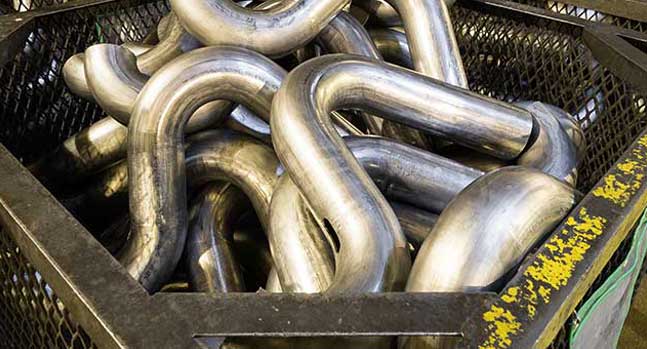
3/4" to 6" diameter bending capacity
Severe radius capability standard - all sizes
Close tolerance available
Large die selection
Bend all tubing materials and shapes.